Free shipping on orders over ₹499| New customers get 10% off!
Dry Food vs Wet Food for Dogs India — Which is Better? | ChowWow
Dry kibble or wet food — which is actually better for your dog in India? We break it down honestly, covering nutrition, cost, Indian climate, and what vets recommend. Read before you buy.
4/28/20267 min read
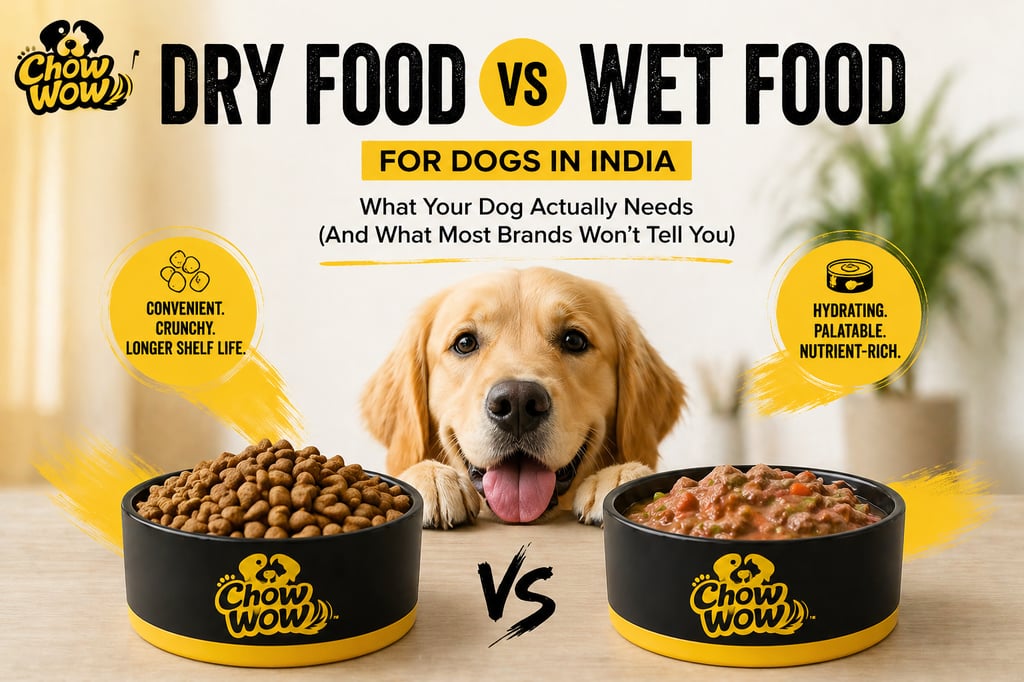
Dry Food vs Wet Food for Dogs in India: What Your Dog Actually Needs (And What Most Brands Won't Tell You)
If you've recently become a dog parent or even if you've had a dog for years this question has probably crossed your mind more than once: should I be feeding dry food, wet food, or some mix of both?
Ask ten people at a dog park and you'll get twelve opinions.
The internet isn't much better. Half the articles are written by brands selling one format. The other half are translated from American or European contexts that don't account for how we actually live in India the heat, the budget realities, the fact that your Labrador is not the same as a golden retriever in Wisconsin.
So let's actually talk through this. No fluff, no brand propaganda.
First, What's Actually in Dry Dog Food (Kibble)?
Dry dog food or kibble is the format most Indian dog parents start with. It's convenient, has a long shelf life, and big brands in india have made it the default choice in Indian households.
But what's actually in it?
Good dry dog food should list a named animal protein - chicken, lamb, fish - as the first ingredient. That first ingredient matters more than anything else on the label. If you see "meat meal" or "poultry by product" right at the top with no specifics, that's a yellow flag.
After protein, the next thing to check is fillers. A lot of mass-market kibble packs in corn, wheat, and soy as the bulk of the product. These aren't toxic, but they're not particularly nutritious for dogs either. Dogs are not naturally optimized to digest large amounts of grain they tolerate it, but they thrive on meat.
What makes a dry food good:
Named animal protein as the first ingredient (chicken, lamb, salmon, etc.)
No artificial colors or preservatives (BHA, BHT, ethoxyquin, avoid these)
At least 22–26% crude protein for adult dogs
Added omega-3 fatty acids for coat health
Probiotics or prebiotic fiber for gut health
The honest upside of dry food:
Shelf stable – can sit in a bag for months
Economical – significantly cheaper per meal than wet food
Convenient for portion control and feeding schedules
The crunching action has mild dental benefits (though it's not a replacement for actual dental care)
What's In Wet Dog Food?
Wet food pouches, cans, trays has a much higher moisture content, typically around 70–80%. This single fact has major implications for your dog's health that most people overlook.
Dogs evolved as carnivores who got most of their hydration from the prey they ate. Unlike cats (who are notorious for being bad drinkers), dogs do drink water but in India's climate, especially in cities like Delhi, Mumbai, Chennai, and Pune where summers are brutal, a dog on 100% dry food is often in a state of mild chronic dehydration. This quietly stresses the kidneys over time.
Wet food solves this passively. Your dog gets protein AND hydration in the same bowl.
What makes a wet food worth buying:
Real meat or named meat broth as the primary ingredient
No artificial thickeners like carrageenan (linked to inflammation in some studies)
Protein content of at least 8–10% in the as-fed state (which equals roughly 40–50% on a dry matter basis)
Clear ingredient sourcing "chicken" not "poultry flavour"
The honest upside of wet food:
Superior hydration critical in Indian summers
Usually more palatable, great for picky eaters or dogs recovering from illness
Easier on the digestive system
Higher protein density by dry matter comparison in premium options
Better for senior dogs with dental issues or those who struggle to chew kibble
The Indian Climate Factor Nobody Talks About
Here's something that doesn't make it into most dog food comparisons: India is not a temperate country.
In most of India, summer temperatures cross 38–42°C routinely. A dog on a dry-only diet in peak summer needs significantly more water to compensate and most of them just don't drink enough, especially if you're out at work.
Adding wet food to your dog's routine during summer months is one of the simplest things you can do for kidney health, coat condition, and overall energy levels. Even one wet food meal a day during peak summer makes a measurable difference.
This is particularly important for breeds that are prone to urinary issues or have naturally lower thirst drives like Shih Tzus, Pugs, and some older Labradors.
Grain-Free Dog Food - Worth It in India?
The grain-free dog food category has exploded in India over the last three years, and the marketing around it can be confusing.
Here's what you actually need to know: grain-free is not automatically healthier.
For dogs with confirmed grain allergies or sensitivities symptoms like itchy skin, recurring ear infections, and loose stools after meals grain-free diets can be genuinely life-changing. But for a healthy dog with no sensitivities, whole food grains like brown rice and oats are a perfectly good source of energy and fiber.
The real issue with low-quality grain-inclusive foods isn't the grain it's the quality of everything. Corn and wheat used as cheap filler bulk are different from oats and brown rice used as a controlled energy source in a well-formulated recipe.
If your dog has no diagnosed sensitivities, you don't need to spend the extra money on grain-free. Spend it on a higher-quality grain-inclusive formula instead.
The one thing to watch with grain-free: Some grain-free formulas use large amounts of legumes peas, lentils, chickpeas as replacements. The FDA has been investigating a potential link between high-legume grain-free diets and dilated cardiomyopathy (a heart condition) in dogs since 2018. No definitive causal link has been established yet, but it's worth knowing if you're choosing grain-free for the long term. Always talk to your vet.
Dry Food vs Wet Food: What Should You Actually Feed?
The honest answer: for most Indian dogs, a combination works best.
Here's a simple framework that works in practice:
If budget is a consideration (and for most of us it is): Use a good quality dry kibble as your base it's the most economical way to meet daily nutritional needs. Add wet food as a topper 3–4 times a week, or swap one meal a day to wet food in summer. This gives you the hydration benefits without the cost of running fully wet.
If your dog is a picky eater: Wet food on top of dry kibble is the single most effective palatability trick there is. The moisture and aroma from wet food make even mediocre dry food more attractive. It works almost every time.
If you have a puppy: Puppies need more protein and fat for growth. A high-protein dry kibble formulated specifically for puppies is important don't just feed adult food. Mix in wet food to add variety and palatability as they're building eating habits.
If your dog is a senior (7+ years): Wet food becomes more important. Older dogs often have reduced kidney function and benefit enormously from added moisture. They may also have dental issues that make crunching hard kibble painful. Wet food or soft kibble mixed with warm water is ideal.
If you have a high-energy or working breed: High-protein dog food dry or wet matters most here. Active breeds like Border Collies, Belgian Malinois, and sporting dogs need more calories and amino acids than a relaxed apartment Pomeranian. Look for food with 28–32%+ crude protein.
How to Read a Dog Food Label in India
This is the skill nobody teaches you when you become a dog parent, and it's more useful than anything else in this article.
The ingredient list: Ingredients are listed by weight before cooking. So "chicken" listed first doesn't necessarily mean the final product is mostly chicken it's mostly chicken before the moisture is cooked out. A better sign is seeing chicken meal (which is already moisture-removed) listed high up, in addition to fresh chicken.
The Guaranteed Analysis: This tells you minimum protein, fat, and maximum fiber and moisture. It's on every pack. Compare brands using dry matter basis calculations to get a fair comparison across dry and wet foods.
"Complete and Balanced": If a food says "complete and balanced," it means it meets the nutrient profiles recommended for dogs either through feeding trials or formulation. A food that says it's "complementary" or a "treat" is not a complete diet and shouldn't be used as a main meal.
Natural preservatives vs artificial: Vitamin E (mixed tocopherols) and rosemary extract are natural preservatives fine. BHA, BHT, and ethoxyquin are synthetic antioxidants used in some budget pet foods and worth avoiding.
What ChowWow Gets Right
At ChowWow, we think about dog food the way we think about our own food: real ingredients, honest labels, nothing to hide.
Our Daily Kibble range is formulated with named animal protein first always chicken or lamb, never vague "meat" and uses brown rice as a whole-grain energy source rather than cheap corn filler. It's a high-protein dry dog food designed for everyday feeding across all life stages, positioned in the mid-range segment so it's actually sustainable for Indian families to feed consistently.
Our Feast Wet Food range is designed to complement Daily Kibble or work as a standalone meal. Made with real meat in gravy or broth, it's the hydration boost your dog needs during Indian summers without the guilt of feeding them something you can't decode.
And our Bites Treats are exactly what training treats should be small, high-value, real-ingredient rewards that don't blow up your dog's daily calorie count.
Every ChowWow product tells you exactly what's inside. Because you deserve to know what you're feeding your family all members of it.
Find ChowWow on Blinkit, Zepto, and Amazon-or shop directly on chowwow.in.
Quick Reference: Dry vs Wet Food at a Glance
Dry Kibble Wet Food Cost per day Lower Higher Hydration Low High Palatability Medium High Shelf life Long (months) Short once opened (24–48 hrs) Dental benefit Mild Minimal Best for Everyday feeding, cost efficiency Summer months, picky eaters, seniors Protein quality Depends on brand Depends on brand
The Bottom Line
There's no single right answer to dry vs wet food and any brand that tells you otherwise is selling you something.
The best dog food in India is one that uses quality ingredients, matches your dog's life stage and health needs, fits your monthly budget, and that your dog actually enjoys eating.
For most Indian dog parents, the smart move is a premium-quality dry kibble as the foundation, supplemented with wet food for palatability, hydration, and variety. Adjust based on season, your dog's age, and any specific sensitivities.
And always – always – read the ingredient label before you buy. Your dog's long-term health is built meal by meal.
Have questions about what to feed your dog? Drop us a message on Instagram @chowwow_pets or write to us at hello@chowwow.in. Wow in every chow.
Connect For
Connect for the Chow, stay for the Wow.
Contact
Newsletter
hello@chowwow.in
9650354810
© 2026. All rights reserved.