Free shipping on orders over ₹499| New customers get 10% off!
How to Read a Pet Food Label in India: FSSAI Guide 2026
Most Indian pet parents never read the back of the pack. Here's exactly what FSSAI requires on every dog and cat food label - and the claims to ignore.
Abhishek rana
5/26/20264 min read
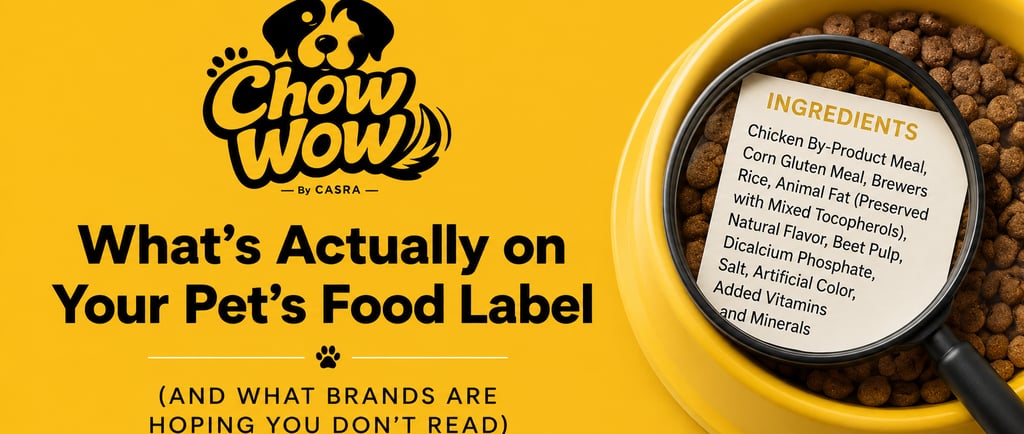
What's Actually on Your Pet's Food Label (And What Brands Are Hoping You Don't Read)
I'll be honest. The first time I really read the back of a pet food pouch, I felt a little stupid. I'd been buying treats for years and never once flipped the pack over to see what I was actually feeding my dog. Just trusted the front, the cute illustrations, the words "premium" and "real chicken" in a friendly font.
Turns out the front of the pack is marketing. The back is the truth. And in India, what goes on the back is governed by the FSSAI - the Food Safety and Standards Authority of India under the Labelling and Display Regulations, 2020. There are rules. Most pet parents have no idea what they are. And some brands are quietly hoping it stays that way.
So here's a plain-English walkthrough of every important thing on the back of an Indian pet food label, what it means, and what should make you put the pack back on the shelf.
1. The veg/non-veg symbol
That little brown filled square (non-veg) or green filled square (veg) inside a square outline, it's mandatory under FSSAI for all packaged food in India, pet food included. For a treat that says "Chicken" or "Tuna" on the front, the symbol on the back has to be the brown non-veg one. Sounds obvious. But check it anyway. If it's missing, that's a red flag right out of the gate.
2. The ingredient list (this is the big one)
Ingredients on an Indian pet food pack have to be listed in descending order by weight. Meaning whatever is first on the list is the largest ingredient by quantity in the pack.
This is where a lot of brands play games. A pack might shout "Real Chicken!" on the front, but when you look at the ingredients on the back, the first item is wheat flour or rice flour or some vague "cereal byproduct," and chicken is third or fourth.
The first three ingredients tell you 80% of the story. If your "chicken treat" doesn't list chicken first, you're basically buying biscuits with chicken flavour.
For single-ingredient treats (think jerky, dehydrated meat), there should be exactly one ingredient on the list. That's the whole point. If a "single ingredient" jerky has six things on the back panel, something's off.
3. FSSAI logo and licence number
Every legitimate pet food sold in India has to display the FSSAI logo and a 14-digit licence number on the pack. No logo, no number - don't buy it. You can actually plug that number into the FSSAI website and verify the manufacturer.
4. Manufacturer details (not just the brand name)
The brand on the front isn't always the company making the food. A lot of Indian pet brands are marketing companies that outsource manufacturing, which isn't a bad thing on its own, but the back of the pack has to declare the actual manufacturer's name and full address. If it just says "Marketed by [Brand]" with no manufacturer info, that's a labelling violation.
5. Net quantity, MRP, and "best before"
These come under Legal Metrology rules, not just FSSAI. Net quantity should be in grams (not "pieces" or "approximate"). MRP should be inclusive of all taxes. And there should be a clear date of manufacturing and a best-before or use-by date.
Quick tip: a manufacturing date that's more than 6 months old on a "fresh" treat is a sign of slow-moving stock or possibly a quick-commerce dump.
6. Feeding guide
This one's underrated. A proper pet treat pack should tell you how many treats per day are safe for what size of pet. Vets generally recommend treats stay under 10% of your pet's daily calorie intake. If a pack doesn't bother giving you a feeding guide at all, the brand either hasn't done the work or doesn't want you to realise how few treats per day actually fit a healthy diet.
7. Nutritional information / guaranteed analysis
You'll usually see something called "Guaranteed Analysis" - crude protein, crude fat, crude fibre, moisture. For a meat-based treat, you want protein high, moisture low, fibre low. A chicken jerky with 12% protein is suspicious. Real jerky usually clears 50–60%.
8. The claims that mean nothing
"Premium." "Natural." "Vet-approved." "Human-grade."
None of these have a legal definition under Indian pet food regulation. They're marketing words. The only claims that have to be backed by something are nutritional ones - like "high protein" or "rich in omega-3" and even those, FSSAI is still tightening rules around.
So when you see "100% natural" on a pack, don't trust the front. Flip it over and read the ingredients. The list will tell you whether the claim holds up.
What to actually do at the shelf
Next time you're picking up a treat - whether it's on quick-commerce at 11pm or at a pet store on a Saturday - give yourself 30 seconds with the back of the pack. Three quick checks:
Is the first ingredient the protein on the front? Is the manufacturer named and traceable? Does the feeding guide make sense for your pet's weight?
If all three are yes, you're probably holding something good. If even one is missing, put it back.
Your pet can't read labels. That part's on you.
Connect For
Connect for the Chow, stay for the Wow.
Contact
Newsletter
hello@chowwow.in
9650354810
© 2026. All rights reserved.