Free shipping on orders over ₹499| New customers get 10% off!
Oven Baked Dog Food vs Regular Kibble India – Which is Better? | ChowWow
Most dog food brands in India use the same high-heat extrusion process. Here's why oven-baked dry dog food is different — and why it matters for your dog's nutrition, digestion, and long-term health.
Abhishek Rana
4/22/20268 min read
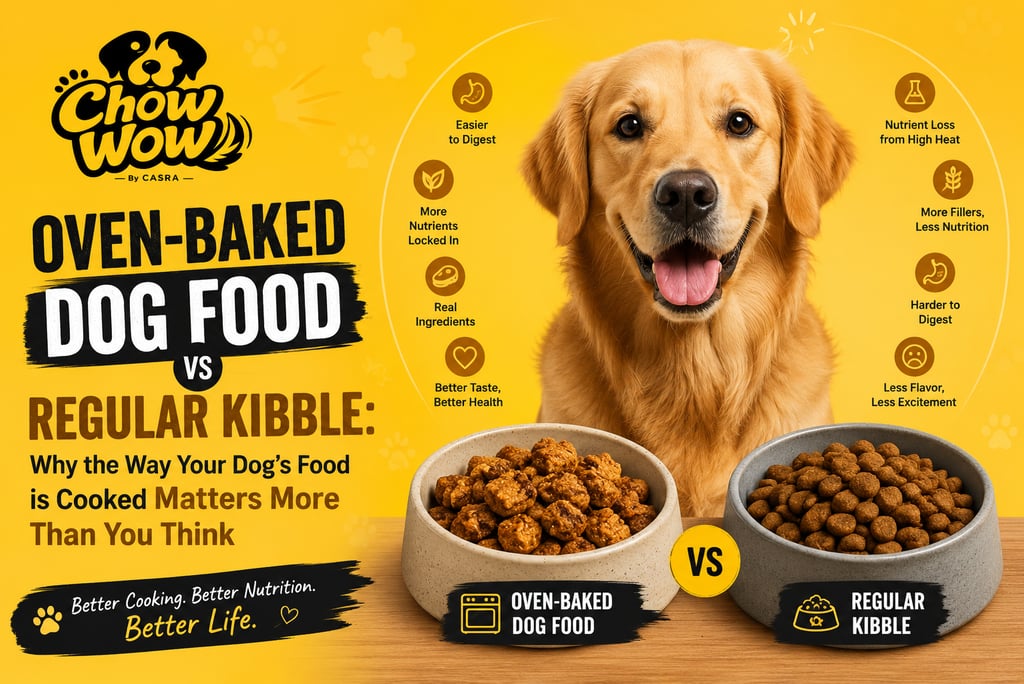
Oven-Baked Dog Food vs Regular Kibble: Why the Way Your Dog's Food is Cooked Matters More Than You Think
Here's something most dog food brands in India don't talk about: the nutritional quality of your dog's food isn't only about what goes into it. It's also about how it's cooked.
Two bags of dry dog food can have nearly identical ingredient lists chicken, rice, vegetables, added vitamins and still differ enormously in nutritional value. Not because one brand is lying, but because the cooking process changes everything.
This is the conversation most pet food marketing skips over. We're not going to skip it.
What Is Regular Kibble And How Is It Actually Made?
The overwhelming majority of dry dog food sold in India including virtually every mass-market brand you've seen on Amazon, Blinkit, or Zepto is made through a process called extrusion.
Here's what actually happens.
Raw ingredients meat meal, grains, vegetables, fats, supplements are mixed into a wet dough. That dough is then fed into a machine called an extruder: a large industrial tube that uses intense heat (typically 150–180°C / 300–360°F) combined with high pressure to cook and push the mixture through small holes at the end. The emerging coils are sliced by a rotating blade into uniform kibble shapes, which expand and puff up as they cool.
The entire process takes a matter of seconds per piece.
The result? Those familiar, light, airy, uniform pieces of dry dog food. Consistent shape, long shelf life, easy to produce at enormous industrial scale, and relatively cheap to manufacture.
But here's the thing that gets glossed over in pet food marketing: those extreme temperatures and pressures destroy a significant portion of the naturally occurring vitamins, minerals, enzymes, and antioxidants in the original ingredients.
This is not a fringe opinion. It's chemistry. Heat-sensitive B vitamins, vitamin C, certain antioxidants, natural enzymes these begin breaking down above roughly 70°C. At 150–180°C under pressure, the damage is substantial.
So what do manufacturers do? They spray the finished kibble with synthetic vitamins, minerals, and fats after the extrusion process to compensate. That post-processing spray is why you see a long list of added vitamins and minerals on the back of most kibble bags. The nutrients aren't primarily coming from the food itself they're being added back after the cooking process destroyed much of what was originally there.
There's also something else worth knowing about extrusion: the process typically requires large amounts of starchy carbohydrates corn, wheat, rice flour to hold the dough together and allow it to expand properly. This pushes the carbohydrate content of extruded kibble higher than necessary, and the protein content lower than the ingredient list might imply.
What Is Oven-Baked Dog Food?
Oven-baked dog food is exactly what it sounds like: dry dog food that is baked in an oven, not pushed through an extruder.
The process is fundamentally different and slower.
Instead of high-pressure, high-heat extrusion, the dough is shaped and then baked on slow-moving conveyor belts at significantly lower temperatures, for longer periods. The food is cooked through gradually, from the outside in, the way you'd roast something in your kitchen oven. It's then cooled slowly and hardened into its final texture.
This slower, gentler baking process has several meaningful consequences for the food that ends up in your dog's bowl.
What Oven Baking Actually Does Differently
1. It preserves more of the natural nutrients
Because oven baking uses lower temperatures typically around 150–175°F (65–80°C) rather than the 300°F+ of extrusion — naturally occurring vitamins, antioxidants, and amino acids in the ingredients survive the cooking process in much greater quantities.
When you start with quality chicken, for example, you want the protein in that chicken to reach your dog's digestive system in a bioavailable form. High-heat extrusion denatures proteins and can damage the amino acid structures that make them useful. Gentle baking preserves them.
The practical result: oven-baked food can deliver real nutritional value from real food, rather than relying almost entirely on the synthetic vitamin and mineral spray that extruded kibble depends on.
2. It's more digestible
There's a real and measurable difference in how dogs digest baked kibble versus extruded kibble.
The slower baking process breaks down the food in a way that's gentler and more compatible with a dog's digestive system. This is particularly noticeable in dogs with sensitive stomachs — the kind who get loose stools with most standard kibble, or who vomit occasionally after meals. Many pet parents who switch to oven-baked food notice that digestive symptoms ease significantly, often within a week or two.
Better digestion also means better nutrient absorption. A more digestible food means your dog actually uses more of what they eat, rather than passing it through. You may actually notice smaller, firmer stools a classic sign that the food is being digested effectively rather than just passing through.
3. The flavour and palatability are naturally better
This one surprises people, but it makes complete sense once you think about it.
Baking caramelizes the natural sugars in the ingredients the same reason roasted chicken smells so much better than boiled chicken. The Maillard reaction (the browning process that happens during baking) develops complex, appealing flavours that dogs respond to genuinely.
Extruded kibble, processed at high speed and then sprayed with palatability enhancers to make it appealing, doesn't develop the same depth of natural flavour. The aroma you smell from a fresh bag of extruded kibble is largely from those sprayed-on coatings, not from the food itself.
Picky eaters notoriously difficult dogs who refuse food regularly often take much better to oven-baked food precisely because it smells and tastes like real food, not processed product.
4. It typically uses denser, higher-quality ingredients
Because oven baking doesn't require the same high-starch dough composition that extrusion does, manufacturers who use oven baking can work with a fundamentally different ingredient ratio.
Extruded kibble needs significant starchy carbohydrate content to function in the extruder. Oven-baked food doesn't have that technical constraint. This means oven-baked formulas can have genuinely higher meat content, lower carbohydrates, and denser overall nutrition all else being equal.
You'll often notice that oven-baked kibble is darker, denser, and heavier piece-for-piece than extruded kibble. That density is a feature, not a flaw. It's a sign of more actual food per piece, less puffed-up air and starch.
5. Fewer or no artificial preservatives needed
The oven-baking process naturally removes moisture from the food in a controlled way, which creates shelf stability without the need for chemical preservatives like BHA, BHT, or ethoxyquin.
This matters in the Indian market, where the warm, humid climate makes storage conditions more challenging than in cooler countries, and where many pet parents are increasingly concerned about synthetic additives in their pets' food.
But Is Oven-Baked Dog Food Actually Better? The Honest Answer
Here's where we want to be straight with you, because nuance matters.
Oven-baked food produced well, with quality ingredients, is genuinely nutritionally superior to extruded kibble because it preserves more natural nutrients, is more digestible, and doesn't rely as heavily on post-process synthetic supplementation.
However and this is important an oven-baked food with mediocre ingredients is not automatically better than a well-formulated extruded food with excellent ingredients. The cooking method matters. The ingredients matter equally.
What oven baking does is raise the ceiling on what dry dog food can deliver nutritionally. With good ingredients, you get genuinely better nutrition than the same ingredients would provide after extrusion. With poor ingredients, baking doesn't save you.
This is why when choosing any dry dog food, baked or extruded the first ingredient must still be a named animal protein. The label must still be honest. The brand must still be transparent.
What This Means for Indian Pet Parents Specifically
In India, almost every dry dog food brand on the market uses extrusion. This isn't because extrusion is the gold standard of pet food production it's because extrusion is the cheapest, fastest, most scalable way to mass-produce kibble.
The oven-baked category barely exists in the Indian market right now. This is actually significant: it means that pet parents who want genuinely better nutrition for their dogs have had very limited options they either had to import premium foreign brands (expensive, with freshness and supply concerns) or accept that all locally available dry food was processed the same way.
This is the gap ChowWow's Daily Kibble range is built to fill.
Introducing ChowWow Daily Kibble – India's Oven-Baked Dry Dog Food
ChowWow Daily Kibble is made using a slow oven-baking process the first of its kind in India's mid-range pet food segment.
Here's what that means in practice:
Real chicken or lamb as the first ingredient, not chicken meal or vague "meat." The protein your dog reads on the label is actually there in bioavailable form when it reaches their bowl.
No artificial preservatives. The baking process and natural tocopherols (vitamin E) keep the food shelf-stable without BHA, BHT, or synthetic antioxidants.
Denser nutrition per piece. ChowWow kibble is visibly denser and darker than extruded alternatives — that's the natural caramelisation from baking, not artificial coloring or coating.
Better digestibility. Formulated for Indian dogs across all life stages, with ingredients and a cooking process that work together for real gut health not just impressive-sounding label claims.
Mid-range pricing. Premium production shouldn't mean only wealthy dog parents can afford to feed their dogs well. ChowWow sits in the accessible mid-range comparable in price to the better-known mid-tier extruded brands, but with a fundamentally different (and better) production process.
Every bag of ChowWow Daily Kibble tells you exactly what's inside and exactly how it's made. Because you deserve to know what you're feeding your dog.
Oven-Baked vs Extruded: Side-by-Side
Extruded Kibble (Standard) Oven-Baked Kibble (ChowWow) Cooking temperature 150–180°C under pressure Lower temps, slow baking Nutrient retention Lower heat damages vitamins, enzymes Higher gentle process preserves more Digestibility Variable Generally higher Carbohydrate content Higher (needed for extrusion) Can be lower Palatability Often relies on sprayed coating Natural caramelisation from baking Preservatives Often artificial Natural (tocopherols) Protein quality Partially degraded by high heat Better preserved Ingredient density Lower (more air, more filler) Higher (denser, heavier pieces) Cost to produce Lower Higher (slower process) Availability in India Widely available ChowWow bringing it to India
Common Questions About Oven-Baked Dog Food
Is oven-baked food safe for puppies? Yes ChowWow Daily Kibble is formulated for all life stages. Puppies actually benefit significantly from more digestible food with better nutrient retention during their critical growth phase.
Does oven-baked food go stale faster? The moisture content after baking is very low, which creates good shelf stability. Store in a cool, dry place, seal the bag between meals, and use within the timeframe on the packaging. In Indian humidity, an airtight container after opening is always a good idea — for any dry dog food.
Can I still mix it with wet food? Absolutely. ChowWow Daily Kibble (baked dry food) pairs naturally with ChowWow Feast Wet Food for maximum palatability and hydration especially during Indian summers.
My dog is a picky eater. Will they accept baked food? Picky eaters often do better with oven-baked food, not worse. The natural caramelisation from baking makes it genuinely more aromatic and flavourful than extruded food coated with synthetic palatability enhancers.
Is this grain-free? ChowWow Daily Kibble is grain-inclusive, using whole grains like brown rice and oats as quality energy sources. Grain-free is not necessary for most dogs without diagnosed sensitivities, and whole-food grains in oven-baked formulas behave very differently from the cheap corn and wheat filler in mass-market extruded food.
The Bottom Line
The pet food industry in India has given dog parents one option for dry food for decades: extruded kibble, made fast, made cheap, and supplemented with synthetic vitamins to make the label look good.
Oven-baked dry dog food is a genuinely different approach. Not just a marketing story — a different production process that delivers real differences in nutrient retention, digestibility, palatability, and ingredient quality.
ChowWow is bringing this format to India for the first time in the accessible mid-range segment. Not because it's a trend, but because it's a better way to feed your dog.
Every meal you put in your dog's bowl is a choice. We think you deserve to make it with good information.
Find ChowWow Daily Kibble on Blinkit, Zepto, Amazon, and chowwow.in.
Wow in every chow.
Got questions about switching to oven-baked food or want help figuring out the right ChowWow formula for your dog? Write to us at hello@chowwow.in or find us on Instagram @chowwow.in.
Connect For
Connect for the Chow, stay for the Wow.
Contact
Newsletter
hello@chowwow.in
9650354810
© 2026. All rights reserved.